
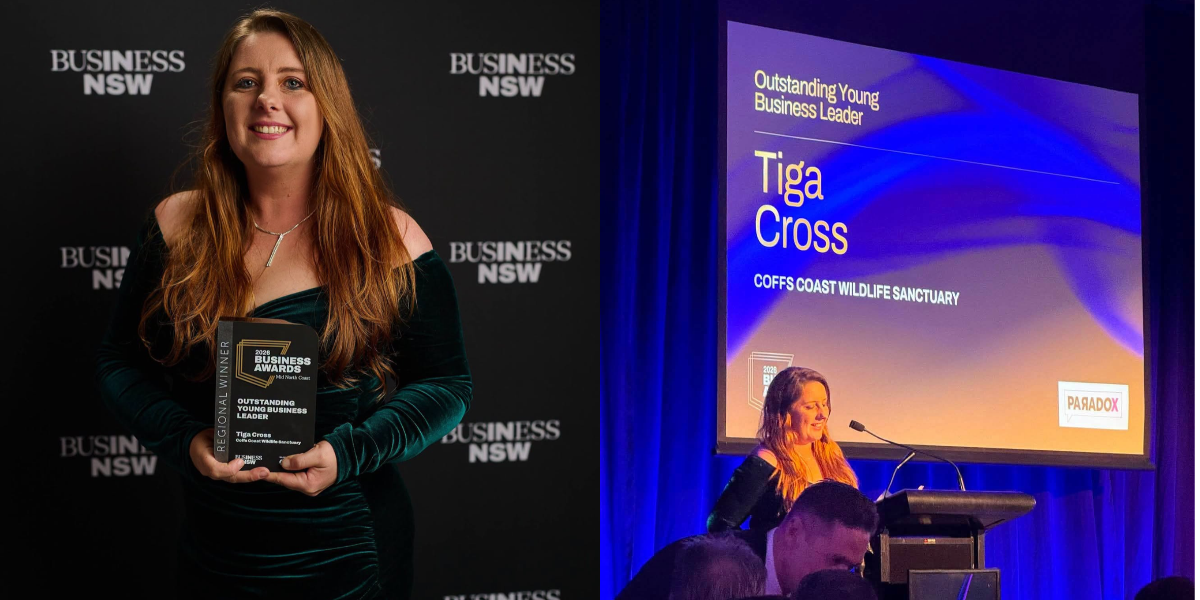
Coffs Coast Wildlife Sanctuary managing director Tiga Cross has been named the 2026 Regional Young Business Leader and will now go on to represent the region at the NSW State Awards.
It is the second year in a row Ms Cross has taken out the regional title, a result she says she did not expect.
“I actually found out by email that I was a finalist, which was really exciting. When my name was announced on the night, though, it was a huge shock,” Ms Cross said. “I was fortunate enough to win the same award last year, and knowing how many incredible young business leaders there are across the Coffs Coast, I genuinely didn’t expect to win two years in a row. It was a very special moment.”
Ms Cross founded Coffs Coast Wildlife Sanctuary after transforming a former tourism attraction into a not-for-profit focused on wildlife rescue, rehabilitation, conservation and education. She said the decision to save the site was never really a choice.
“It wasn’t so much about what I saw the old tourism attraction becoming; it was about what the alternative meant. The facility closing, animals potentially losing their home, my team losing their jobs, wildlife rescue work being lost and our community losing an important asset just wasn’t an option I was willing to accept,” she said. “So, in my mind, there really was only one option: fight to save it and transform it into something with a bigger purpose.”
Ms Cross said the award was not hers alone, pointing to the Sanctuary’s team, volunteers, community, local businesses and her family.
“It’s honestly not just one or two people; it’s our whole team, our volunteers, our community, local businesses and my family who have stood beside us,” she said.
She singled out her husband, Brian, for particular thanks.
“It might sound cliché, but I especially have to thank my husband, Brian. He has sacrificed so much to help make this dream possible, leaving his own job, taking on more of the parenting responsibilities and even mortgaging our family home alongside me to save the Sanctuary. He’s not one for the spotlight, but he works just as hard behind the scenes, somehow balancing being my husband, Akira’s dad and my business partner, which isn’t always easy,” she said.
Ms Cross said the public rarely sees the full scale of work behind the Sanctuary’s rescues and milestones.
“It is SOOOO much more work than people see. Behind every rescue, new project or exciting announcement there is an enormous amount of compliance, paperwork, accounts, staffing and day-to-day management,” she said. “People hear ‘not-for-profit’ and often assume we must be funded by government or council, but we aren’t. At its heart, CCWS is a family-operated charity. My husband and I, alongside our incredible team and volunteers, put everything we have into keeping it going.”
Asked whether she had ever considered stepping away, Ms Cross said the thought never lasted long.
“There are definitely moments where I think, ‘This is SO hard!’ but that thought usually only lasts a second. Then I’m reminded of the impact we’re creating. Whether it’s an animal we’ve been able to rescue and return to the wild, a disadvantaged young person who has found confidence and purpose through one of our programs, or the difference we’re making within our community, those moments make the hard days worth it,” she said. “I’ve come too far and believe too strongly in what CCWS can become to give up now.”
She said her years in leadership roles had shaped a philosophy built on working alongside her team rather than above them.
“I’ve been in leadership roles for many years, and for me it has always meant being part of the team, not leading from above. I’m happy to get on the ground, do the hard jobs and understand the struggles my team is facing, because that’s how I know what needs to change,” she said. “To me, being the leader doesn’t put me at the top; it simply means I’m the voice for the team I lead.”
Looking ahead, Ms Cross said the Sanctuary’s long-term goal is to establish a fully self-sustaining wildlife headquarters for the Mid North Coast, supporting rescue, rehabilitation, release, conservation, research and education under one roof. A wildlife hospital is part of that vision, though she said it remains some way off. In the meantime, the Sanctuary is raising funds for a Wildlife Triage Trailer, a mobile unit she describes as a hospital on wheels.
“What excites me most is that we’re getting so close to being able to expand beyond marine wildlife and help ALL wildlife, from frogs, koalas and birds to turtles, dolphins and whales. That’s the next chapter, and it feels like we really are only just getting started,” she said.
Ms Cross said there are many ways for locals to get involved with the Sanctuary, including volunteering, disability-inclusive programs, wildlife rescue opportunities, career and student pathways, and education programs such as Eco Kiddos.
“Depending on your age, ability, stage of life and goals, there is almost a pathway for everyone to be part of what we’re building,” she said. “As a not-for-profit charity, what we always need is support, whether that’s your time, skills, a donation, visiting the Sanctuary or simply helping spread the word. Every person who gets involved helps us do more for wildlife and our community.”
Ms Cross will now represent the Coffs Coast at the NSW State Awards.
Something going on in your part of the North Coast people should know about? Let us know by emailing newsdesk@nctimes.com.au