

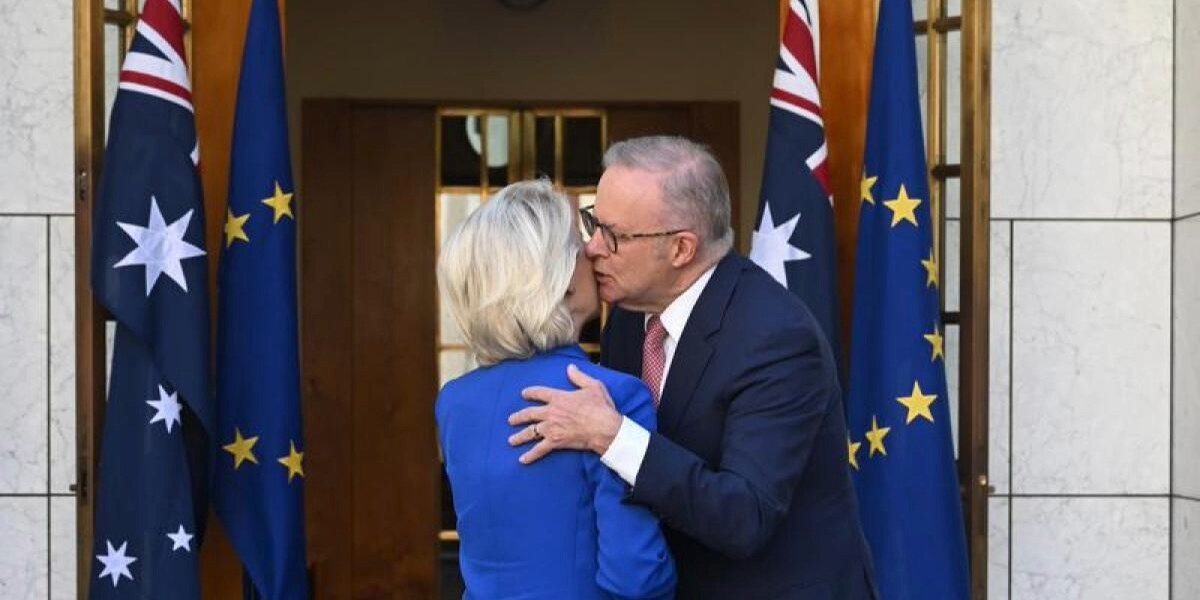
Australia has struck a landmark trade agreement with the European Union after almost a decade of negotiations, opening the door to cheaper European goods and expanded access to a market of 450 million people — but triggering a fierce backlash from farmers who say they have been left behind.
The deal will see Australia remove a five per cent tariff on a wide range of European imports, making products like cars, wine, fashion and food cheaper for Australian consumers. In return, the European Union will eliminate tariffs on most Australian exports, including critical minerals, manufactured goods and many agricultural products.
Business groups were quick to welcome the agreement, describing it as a major step forward at a time of global economic uncertainty.
Business Council of Australia chief executive Bran Black said the deal would lower costs, support jobs and help Australian companies compete globally.
“This free trade agreement gives Australian companies better access to one of the world’s largest markets and puts them on a more level playing field with global competitors,” he said.
“With one in four Australian jobs dependent on trade, continuing to build on that success is critical to driving growth, investment and better living standards for all Australians.”
Prime Minister Anthony Albanese also framed the deal as a significant strategic and economic win, describing it as a “defining moment” in Australia’s relationship with Europe.
“This is a significant moment for our nation as we secure an agreement with the world’s second-largest economy,” he said.
“I am proud that we have been able to secure this deal, which will deliver benefits for both Australia and the European Union for generations to come.”
The agreement will see 98 per cent of the current value of Australian exports enter the EU duty free, with gains expected across sectors including wine, dairy, grains and seafood. Australian businesses will also gain access to European government procurement markets worth an estimated $845 billion annually.
Trade Minister Don Farrell said the deal would help exporters diversify at a time of global instability.
“More trade, with more trading partners means more supply chain security, more well-paying jobs, cheaper prices, and more national income,” he said.
But while the government and business community hailed the agreement, the response from agriculture — particularly the red meat sector — was sharply critical.
The National Farmers’ Federation said the deal failed to deliver “commercially meaningful” improvements in market access, despite years of negotiations.
NFF president Hamish McIntyre said farmers would be left paying the price.
“What the Australian Government has accepted today appears to offer no material change for key agricultural commodities as what the Government rightly rejected in October 2023,” he said.
“Farmers will rightly be concerned this deal hasn’t delivered commercially meaningful access for Australian agricultural exports.”
He said the outcome was particularly disappointing given the mounting pressures facing the sector, including global conflict, trade volatility and existing tariffs.
“Market access is the lifeblood of Australian farmers who do not rely on Government subsidies,” he said.
The strongest criticism came from the red meat industry, which labelled the agreement the worst free trade deal Australia had signed.
Under the deal, Australia secured additional quotas of 30,600 tonnes of beef and 25,000 tonnes of sheep meat annually — figures well below what industry groups had been seeking and significantly less than quotas granted to competitors such as New Zealand.
Andrew McDonald, chair of the Australia–EU Red Meat Market Access Taskforce, said the outcome was deeply disappointing.
“Australia’s red meat sector has been profoundly let down by this outcome,” he said.
“To land a deal so far below what other suppliers have secured is genuinely bewildering.”
He said the agreement entrenched long-standing barriers to entering the European market and failed to deliver the “free and fair trade” outcome industry had been promised.
“This is unquestionably a missed opportunity for Australia’s red meat producers, processors and exporters,” he said.
Meanwhile, new National Party leader Matt Canavan dubbed it the “worst trade deal ever”.
Beyond agriculture, the agreement also includes provisions to deepen cooperation between Australia and the EU on defence, cyber security and research, reflecting a broader strategic alignment amid growing global uncertainty.
European Commission President Ursula von der Leyen said the deal offered stability at a time when countries were seeking more predictable economic partnerships.
“Countries are longing for stability and predictability, and this is what the European Union is offering,” she said.
“You have a free-trade agreement and both sides are winning.”
The agreement also resolves long-running disputes over geographical indicators, allowing Australian producers to continue using terms like parmesan and kransky, while phasing out others such as feta, romano and gruyere over time. Australian winemakers will be able to continue using the term prosecco domestically but must phase it out for exports over the next decade.
Something going on in your part of the North Coast people should know about? Let us know by emailing newsdesk@nctimes.com.au