

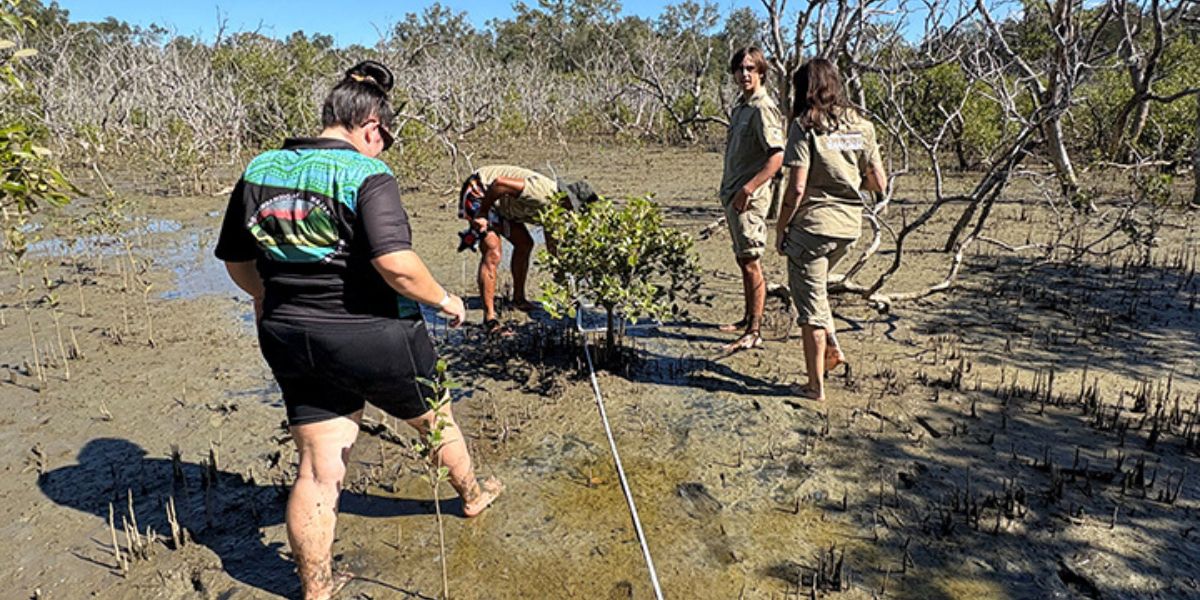
Underwater video cameras and environmental DNA testing will be used to monitor fish populations and estuary health across Gumbaynggirr Sea Country as part of a new Southern Cross University-led research project on the NSW Mid North Coast.
The project, Empowering Indigenous communities to monitor and measure estuary health and cultural resources in Gumbaynggirr Sea Country, has secured $199,317 over three years through the NSW Environmental Trust’s Environmental Research Grants Program.
Southern Cross University will partner with Ngiyambandigay Wajaarr Aboriginal Corporation and Yurruungga Aboriginal Corporation to assess estuary health and cultural resources at key sites including Boambee Creek, south of Coffs Harbour, and the Bellinger River at Urunga.
The initiative combines scientific monitoring techniques with Indigenous ecological knowledge, with Indigenous rangers working alongside a Southern Cross University PhD candidate to develop technical skills in estuary management.
NSW Environmental Trust Manager of Contestable Grants Josh Keating said the program supported innovative environmental research and practical solutions to protect ecosystems across the state.
“By supporting this work, we are empowering researchers and communities to find smarter, more sustainable ways to protect our environment for future generations,” Mr Keating said.
Southern Cross University lead investigator Professor Kirsten Benkendorff said the project built on previous collaboration with Gumbaynggirr rangers studying mangrove ecosystems in Boambee Creek.
“This project builds on our successful collaboration with the rangers to investigate impacts on the local mangrove ecosystems in Boambee Creek,” Professor Benkendorff said.
“The survey protocols will be co-designed with Traditional Owners to tread lightly on Country, whilst collecting valuable data.”
The project will use a range of monitoring methods, including Baited Remote Underwater Video systems, known as BRUVs, which use underwater GoPro cameras and bait arrays to monitor fish diversity and populations.
Researchers will also collect water and sediment samples for environmental DNA testing, known as eDNA, which allows multiple species to be identified from traces of genetic material left in waterways.
Contaminant testing of local seafood stocks will also be undertaken to assess habitat health and food safety.
Yurruungga Aboriginal Corporation chief executive Dean Kelly said the project reflected the community’s cultural responsibility to care for Country.
“As the Descendants of the Budaabangbari, Southern Gumbaynggirr, we are guided by our senior elders and a profound cultural obligation to protect and care for our Country,” Mr Kelly said.
“The Gumbaynggirr people have a long history of connection to the sea, river, creek, and mangrove ecosystems. Integrating modern scientific methods – such as environmental DNA sampling and baited underwater cameras – allows us to monitor changes in our estuaries in direct alignment with our Indigenous seasonal calendar.”
Mr Kelly said the project would support two-way knowledge sharing while creating professional development opportunities for Indigenous rangers and researchers.
“True conservation relies on structural, two-way knowledge sharing,” he said.
“Through this partnership, and in the spirit of ngalan-junaaygam (agreement), we continue our shared, vital responsibility to safeguard, nurture, and advocate for our lands and waters for the generations to come.”
Ngiyambandigay Wajaarr Aboriginal Corporation chief executive Katrina Widders said the organisation was proud to support the initiative.
“We are proud to be working together for the protection and preservation of Country and Cultural values,” Ms Widders said.
“This work continues the vital responsibility shared by our communities to safeguard, nurture, and advocate for our lands and waters.”
Professor Benkendorff said the project would provide valuable information for the future management of estuaries across Gumbaynggirr Sea Country.
“Overall, this project hopes to improve connection of Traditional Owners to Baru Baruga (mangroves) in Gumbaynggirr, provide new information for the evolution of Indigenous Ecological Knowledge and facilitate ongoing management of our local estuaries,” she said.
Advertising with North Coast Times is a cost effective and reliable way to reach locals who are interested and engaged. Find out more here.