

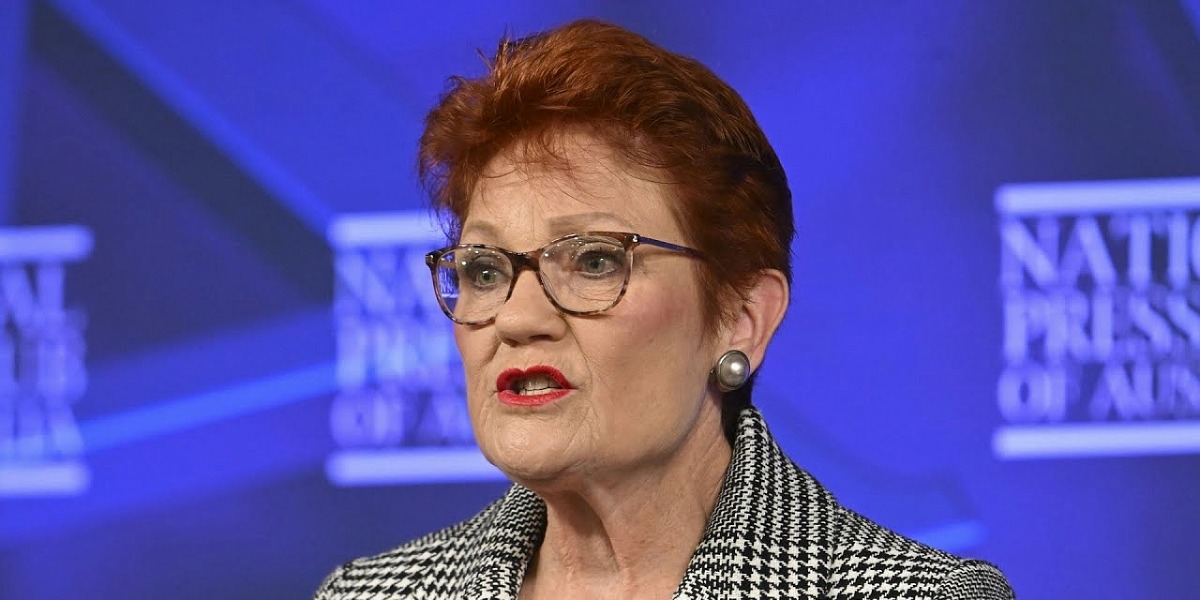
One Nation leader Senator Pauline Hanson addressed the National Press Club in Canberra on Wednesday, setting out her party’s positions on immigration, energy, the economy and a string of social and cultural issues before taking questions from the press gallery.
What follows is a record, organised by topic, of what Hanson said in her own words during the speech and the question and answer session that followed. We’ve used AI to assist in preparing this summary so as to avoid any potential bias in interpretation or editing.
Migration and population
Hanson said immigration levels under the Albanese government were too high and argued the country must move from a policy of multiculturalism toward what she called a monocultural model, in which migrants live under a single set of Australian values and traditions rather than retaining separate cultural identities. She said Australia was a multiracial society but should not be a multicultural one, and called for migrants to learn English before they arrive so they can assimilate into the workforce and the community. She said her party’s policy was to restrict immigration, particularly from countries she associated with religious extremism.
“We cannot be a multicultural society, we are a multiracial society, but we must be monocultural.”
Housing
Hanson linked the housing affordability crisis directly to immigration levels, arguing that population growth has outpaced the supply of new homes and pushed up rents. She criticised the Albanese government’s proposed changes to negative gearing, saying they would discourage investment in housing rather than help renters or buyers. She said she had tried, unsuccessfully, to secure a national plebiscite on immigration numbers two years ago, which the Senate voted down.
“If you make a change to negative gearing, investment will move away from housing.”
Muslims and radical Islam
Hanson said she was not opposed to Islam generally but was focused on what she called radical Islam, which she described as a threat to community safety. She said preachers in some Sydney mosques who “hate this country” should be deported if they were born overseas, or face prosecution under existing law if they were born in Australia. Asked directly whether Australia was in danger of being “swamped” by Muslim migration, she said her concern was specifically with radical Islam rather than Islam as a whole, and pointed to people on security watch lists and the Bondi attack as reasons for her position.
“If we want a secure and peaceful world, radical Islam must be destroyed. There is no place for it in Australia, and my party and I won’t tolerate it.”
Cost of living and welfare
Hanson described rising rates of food insecurity, rental stress and homelessness, citing recent reports from welfare organisations on Australians skipping meals, going without heating, and children attending school hungry. She referred mockingly to Energy Minister Chris Bowen by the nickname “Peanut Bowen” while questioning his promises about energy reliability and affordability. She said the underlying driver of cost-of-living pressure was government energy policy, which she described as having been built around what she called the “hoax” of climate change.
“These figures are appalling and totally un-Australian for a rich country such as ours.”
Energy policy
Hanson said One Nation would end government subsidies, grants, tax incentives and concessional finance for renewable energy projects, including funding administered through the Clean Energy Finance Corporation, which she described as benefiting renewable projects over small businesses and farmers. She said the party would block new wind and solar developments on agricultural land, support continued use of coal and gas, build a nuclear reactor on the east coast, and cancel the Snowy Hydro 2.0 project, which she said had blown out in cost.
“One nation will end this renewable energy bribery, grants, tax incentives, concessional finance, even the government underwriting anything that sponsors the whole net zero hoax.”
Tax, debt and the economy
Hanson said Australia was one of the most highly taxed countries in the world and flagged a broader review of the tax system ahead of the next election, including allowing pensioners, veterans and students to work unlimited hours without losing benefits, and introducing income splitting for families. She compared current government spending to that of the Whitlam government, which was dismissed in 1975 over its economic management, and said Labor should face the same fate. She said she opposed an inheritance or “death duties” tax, which she claimed the major parties would introduce, and criticised changes to capital gains tax arrangements affecting younger investors. Asked whether a One Nation government would push for more influence over Reserve Bank interest rate decisions, she said the bank’s independence should be respected and that government spending, not the central bank, was the problem.
“We have to overhaul our tax system. We are one of the highest taxed countries in the world.”
NDIS
In the same answer on government spending, Hanson said the National Disability Insurance Scheme needed an overhaul to remove people she described as exploiting the system, rather than cutting support for people who genuinely need it. She credited former minister Bill Shorten with handling the scheme well, and criticised former Coalition ministers Stuart Robert and Linda Reynolds over their handling of the portfolio.
“What we need to do is go after the rorters, the scammers, the people that are ripping off the system.”
Workplace relations and wages
Responding to a question listing her record on minimum wage increases, same job same pay laws, casual workers’ rights and gig economy protections, Hanson said small businesses were struggling with rising costs, particularly electricity, and that wage decisions needed to balance worker pay against what businesses could afford. She denied there was a gender pay gap, asserting the difference reflected women taking time off work to raise children rather than unequal pay for the same work.
“You need to look at the other side of the ledger, can businesses afford to pay that?”
Free speech and political trust
Hanson said many Australians were too afraid to express their political views publicly because of how they might be treated, and described this as a tragedy for Australian democracy. She pointed to the failure of the Voice to Parliament referendum as evidence that Australians were not willing to have major changes imposed on the country without their direct say. On a separate question about whether a constitutional right to free speech would also apply inside One Nation, she defended restrictions on branch members speaking to media, saying this followed past experience with internal disputes in branches.
“The real tragedy is people are frightened of what will happen to them if they just speak up.”
Transgender rights
Hanson described what she called a “transgender insurgency” spreading through government bodies, workplaces and schools, and said she would dismiss the Sex Discrimination Commissioner and the President of the Human Rights Commission, Hugh de Kresta, if One Nation were in government. She likened the transgender movement to militant Islam and asserted it was seeking to redefine humanity and biology.
“This transgender ideology is infecting all of society. It is explicitly subversive. There seems to be no boundaries, as it has become part of the propaganda being imposed on kids in classrooms.”
Artificial intelligence
Hanson described artificial intelligence as the most significant economic shift since the Industrial Revolution and criticised the Albanese government for leaving its regulation largely to industry. She said One Nation supported the adoption of AI but wanted enforceable rules to protect people’s rights, safety, employment, privacy and democratic participation, while acknowledging her party did not yet have a detailed policy.
“AI should not be left entirely to self-regulation. Public trust is essential for widespread adoption.”
Media
Hanson said she would abolish SBS, arguing the internet has replaced its function, and would move the ABC to a subscription-only model in cities while retaining some taxpayer funding for regional and remote services. She accused the ABC of political bias and said she had banned and would continue to ban both the ABC and Guardian Australia from access to her. She rejected suggestions that her party should hold daily press conferences during the campaign, saying she would decide on media access closer to the election, and said she was answerable to the public rather than to journalists.
“Taxpayers will still fund some of the ABC operations in regional, rural, and remote areas, where there is a lack of commercial media, but in the cities which are already saturated with media outlets across the political spectrum, the ABC will only be subscription service only.”
Foreign aid, fuel security and China
Hanson said Australia should reduce foreign aid to countries she said misused it through corruption, citing Papua New Guinea, and argued domestic poverty should be addressed before increasing aid abroad. She raised concern about recipient countries also accepting Chinese investment through the Belt and Road Initiative, and said Australia’s reliance on imported fuel and fertiliser, including from Muslim-majority neighbours such as Indonesia and Malaysia, reflected a longstanding failure to maintain domestic refining and manufacturing capacity that needed to be reversed.
“China is a real big concern to me.”
United Nations
Hanson said Australia should not be bound by international bodies such as the United Nations or trade conditions imposed by blocs such as the European Union, citing a past experience in which the EU linked a free trade discussion to Australia’s climate policy compliance. She said this reflected a broader loss of national sovereignty that One Nation would reverse.
“I believe in our own sovereignty. I believe in our own governments, and I don’t believe that we should be dictated to the UN or other countries.”
Indigenous affairs
Hanson said she would abolish the National Indigenous Australians Agency and redirect its funding into general government revenue, so that assistance would be allocated according to individual need rather than race. She said existing Indigenous-specific programs lacked accountability and had failed to improve outcomes in education and health.
“My vision for Australia is that we’re all Australians, regardless of race, colour, creed, where you are, we’re all treated as Australians equally on an individual needs basis, not based on race.”
Public service
Hanson criticised the federal public service as poorly managed and said government ministers were too reliant on advice from bureaucrats rather than across their own portfolios. She said a One Nation government would direct departments on implementing legislation rather than the other way around.
“We will go to the departments and heads and say, this is it, this is how you run it, not the other way around.”
Abortion
Hanson said she opposed late-term abortion, describing an abortion performed the day before birth as unacceptable, and said an abortion at 39 weeks was not humane. She said she considered 20 weeks “too late” but did not commit to a specific gestational limit, saying it required broader public discussion. She said she supported access to abortion for medical reasons or in difficult circumstances and would maintain an exception where the mother’s life was at risk, and said she preferred greater promotion of contraception over reducing the rate of abortion.
“To abort a baby the day before birth is abhorrent and disgusting, and that’s what I oppose,” Senator Hanson said.
Childcare
Hanson said the federal subsidy scheme for childcare needed a full investigation into how funds were being spent and questioned whether qualifications required of childcare workers were necessary. She suggested funding might be better directed to parents directly rather than to childcare centres, and declined to say whether recent pay rises for childcare workers were justified without further investigation.
“Childcare is completely out of control. I think we need to have a complete investigation into it, where the money’s going.”
Party structure, vetting and donations
Hanson said One Nation had introduced a more thorough vetting process for candidates and staff, including international checks and reviews of social media history, and said the party had restricted new branches from forming until members had been vetted, following past internal disputes. She explained she had not had branches until last August because of the number of issues they had with branches the first time she was running the party.
“We’ve had a lot of enthusiastic people that have come on board to join One Nation, we’ve restricted these people until we know who they are.”
Gina Rinehart’s jet
At the start of her address, Hanson responded to suggestions, which she attributed to Channel Nine, that a private jet provided to her by mining magnate Gina Rinehart must have broken down, after she was seen travelling on a commercial flight in economy class. She said the jet was fine and confirmed she had flown economy to Canberra for the address.
“No, Gina’s jet is not broken, and I didn’t come cattle class, or I did come cattle class, actually,” Senator Hanson said.
Tim Fisher “witch” claim
Asked to substantiate a claim that the late National Party leader Tim Fisher had once said Hanson should be “burnt at the stake,” which Fisher denied during his lifetime and which his biographer has said cannot be verified, Hanson said she stood by the claim and recalled reading it in a newspaper in the mid-1990s, though she could not say which publication or provide further evidence.
“I’m not mistaken,” Senator Hanson said.
Daughter’s political staffer role
Asked about her daughter Lee Hanson’s taxpayer-funded role as a political adviser to a New South Wales senator while reportedly campaigning for One Nation in Tasmania, Hanson denied any involvement in her daughter’s appointment and said she had been hired on merit, citing her background in human resources and prior work at the University of Tasmania. She rejected the suggestion that the arrangement was inappropriate, noting other parliamentary staff have worked remotely from interstate.
“No, she didn’t. I didn’t get her that job. She got the job on her own merits,” Senator Hanson said.
Court judgment over campaign expenses
Asked why a former South Australian party leader, Jennifer Game, had to take Hanson to court to recover campaign expenses, resulting in a summary judgment in the Adelaide Magistrates Court last week, Hanson said Game had originally claimed $30,000 in expenses that did not meet the party’s reimbursement criteria.
“She was asking for 30, but she only got 15,” Senator Hanson said.