

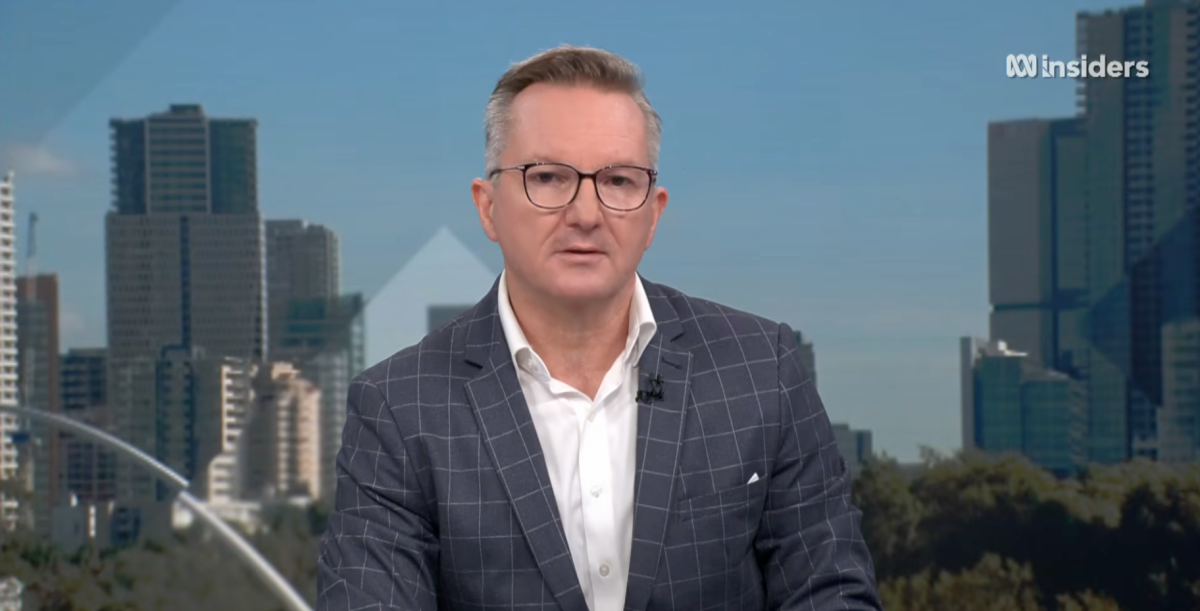
The federal government is refusing to trigger emergency fuel powers despite persistent shortages across regional Australia, with Energy Minister Chris Bowen declaring “we’re a long way” from invoking the Liquid Fuel Emergency Act.
The comments, made on Insiders on Sunday, come as independent distributors warn rationing is already becoming unavoidable, with supply failures forcing closures and leaving some communities without fuel.
Transwest Fuels has again been unable to secure consistent diesel and petrol supply, shutting its North Store at Manilla for the weekend and reporting outages in towns including Mungindi and Walcha.
Bowen insisted the national supply picture remains stable, pointing to stock levels and continued imports.
“We updated our figures yesterday, as we do weekly now, and actually supply of petrol has gone up a little bit, 38 days’ worth of supply, and diesel and jet fuel both at 30 days, which is pretty flat,” he said.
“That indicates that while we’ve released more from the strategic reserve, the ships continue to arrive in good numbers, and both our refineries are working full pelt, and they’re entirely 100 per cent dedicated to Australian supply, not exports.”
He said Australia was seeing “the same, if not slightly more, level of petrol and diesel in Australia than we did just before this crisis began” even as global supply chains remain under pressure.
But when pressed on why service stations, particularly in regional areas, cannot access fuel, Bowen acknowledged a breakdown between supply and distribution.
“What we’ve dealt with is a combination of things. Obviously we’ve had a huge spike in demand, and that’s just a fact, a 100 per cent increase in demand in a few days,” he said.
“Any commodity with a supply chain is not going to cope with that when demand doubles.”
He said the surge had been compounded by structural challenges in regional distribution.
“In regional areas, the supply chain is the hardest to manage. It takes longer to get from Geelong and Brisbane to the various regional areas,” he said.
“You’ve also got lots of rural suppliers, distributors, and service stations working on very tight margins and not always able to access fuel that’s available.”
Bowen confirmed that supply is currently being prioritised to contracted customers, leaving independents operating in the spot market with limited access.
“What the refineries have had to do is, understandably, under the law, prioritise those for whom they have contractual obligations. The spot market hasn’t really been operating, and all that’s had its biggest impact on rural and regional Australia,” he said.
That reality mirrors the experience of independent distributor Transwest Fuels, which has warned it is being squeezed out of supply despite being critical to keeping regional communities functioning.
“Our entire business is on a handshake. That’s the Australian way, and now we’re being punished for it,” Transwest Fuels owner Bill Clifton said.
He said the situation has reached a point where rationing is inevitable – even without government intervention.
“If the government doesn’t step in and start having these harder discussions effectively, there will be a ration system put in place, even in our own business, we’ll just have to do it,” he said.
“We just can’t give everyone everything all at once.”
Clifton described the difficult choices now confronting distributors, who are being forced to decide how limited fuel is allocated across essential sectors.
“Who do I give it to? Councils? Hospitals? Farmers? Construction? Livestock?” he said.
“I don’t think it’s fair that someone like me or the other independents need to make those sort of decisions.”
He also warned that rising prices are compounding the crisis by reducing purchasing power, even when fuel is available.
“If my business has a $20 million credit facility each month to purchase fuel, when the fuel price goes to $3 we need three times the credit limit,” he said.
“Our capacity to buy product is reduced by 50 per cent.”
Despite those warnings, Bowen said the threshold for invoking emergency powers has not been met.
“The national fuel emergency act has never been invoked, ever, not through the first two Gulf Wars or COVID. It’s not designed to be invoked lightly,” he said.
“I would need to be satisfied that there’s a real shortage and that the powers under that act are useful.”
He said any decision would require formal advice and coordination across governments.
“I wouldn’t exercise those quite remarkable powers unless I had pretty strong advice that it was necessary in the circumstances,” he said.
Bowen emphasised that governments are relying on existing contingency plans and market coordination before considering more drastic intervention.
“There’s a national liquid fuel emergency policy response which runs through the different powers that states and territories have and what you do before you get there, voluntary measures, encouragement,” he said.
“We’re a long way from that.”
North Coast Times is new! Connect with us by sending press releases to newsdesk@nctimes.com.au or enquire about advertising with us by emailing ads@nctimes.com.au.