

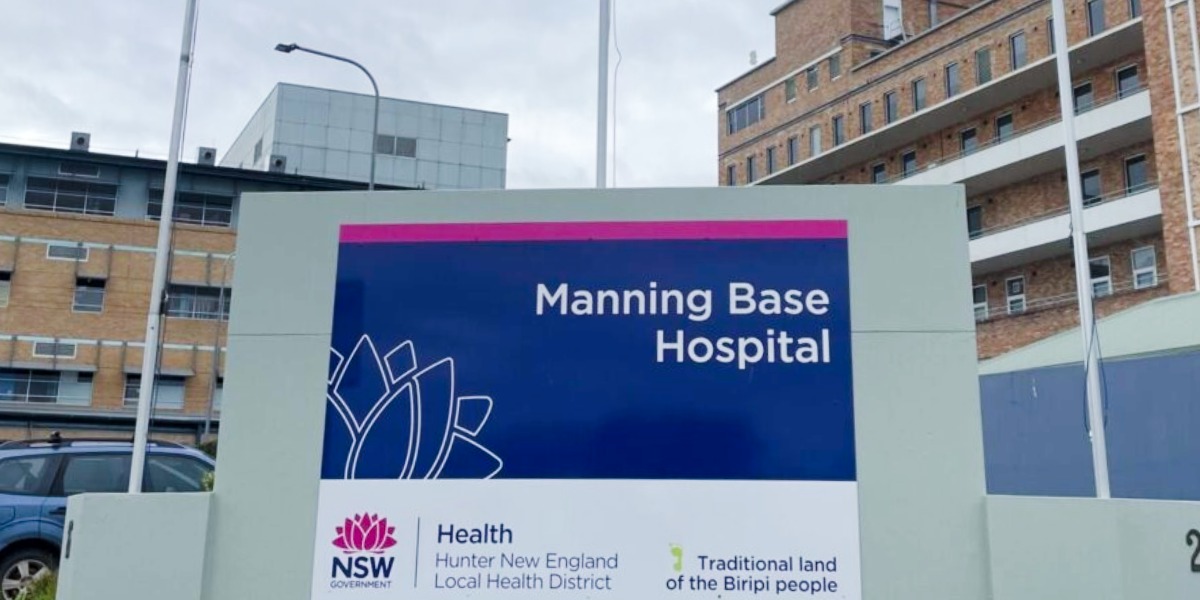
The Minns Government has been accused of stalling on the redevelopment of Manning Base Hospital, with the Opposition claiming the community is being left “in the dark” about the project’s progress and the future of critical health services in the region.
Shadow Minister for Health and Regional Health Sarah Mitchell and Member for Myall Lakes Tanya Thompson have both raised concerns about delays, warning that uncertainty is undermining confidence in the delivery of healthcare for the Manning and Myall Lakes communities.
Thompson said a recent meeting with the office of Health Minister Ryan Park had failed to provide clear answers, describing the discussion as a “complete waste of time” and reinforcing fears the redevelopment was not being prioritised.
“Our community deserves leadership that is focused on delivering equitable healthcare across the entire Hunter New England region, not just in the major centres,” she said.
She said the meeting confirmed concerns that the redevelopment was being delayed while essential services risk being reduced or excluded.
“People across the Manning and Myall Lakes region are tired of excuses.”
Thompson said she was particularly alarmed by indications that cardiac services may not be prioritised in the redevelopment, despite strong demand in the region.
“To hear that cardiac services are not considered a priority for our region is deeply concerning and completely out of touch with the needs of our growing community,” she said.
The issue is especially significant given the demographics of the electorate, which has one of the oldest populations in NSW and a corresponding higher need for cardiac and complex care services.
Mitchell said the lack of clarity around the redevelopment timeline and scope was unacceptable, particularly given the importance of the hospital to surrounding communities.
“The Minns Labor Government must stop playing politics with regional healthcare. This is simply not good enough,” she said.
In response, Hunter New England Local Health District said the redevelopment is progressing, with planning and early works already underway and construction expected to begin later this year.
Executive Director of Infrastructure, Planning and Sustainability John Barnard-Richardson said Stage 2 of the Manning Hospital redevelopment forms part of the NSW Government’s broader $180 million Lower Mid North Coast Health Service Project.
He said the project would deliver a modern clinical services building designed to support high-quality care for local communities, including new inpatient units and a Close Observation Unit to support cardiac patients.
The redevelopment will also include upgraded mortuary, pharmacy and pathology facilities, along with improved integration with the existing hospital building and provisions for future expansion.
Barnard-Richardson said key preparatory work is already underway, including site investigations and surveying, while Hansen Yuncken has been appointed as the early contractor involvement partner to finalise designs ahead of construction.
He said the main works contract is expected to be awarded in the coming months, with the project building on enabling and demolition works completed last year.
The health district also defended its approach to cardiac care, noting that Manning Hospital operates as part of a broader network of facilities across Hunter New England.
“All cardiac patients at Manning Hospital are clinically assessed to ensure they receive care in the most appropriate setting,” Barnard-Richardson said.
“Where a higher level of care is required, patients may be transferred safely to John Hunter Hospital, which provides specialist cardiac services. This is consistent with how specialist care is provided across the state.”
However, the Opposition argues that reliance on transfers does not replace the need for expanded local services, particularly in a region with an ageing population and increasing healthcare demand.
The cost of being transferred to other facilities is also a heavy burden for regional people, with the cost and logistics of getting home falling entirely on the patient.
Concerns have also been raised about delays to a proposed urgent care service for Forster, which had been intended to reduce pressure on Manning Base Hospital and improve access to care for local residents.
“This Urgent Care Centre was meant to relieve pressure on the hospital and improve access to care for local families, yet we continue to see delay after delay with no clear answers,” Mitchell said.
The urgent care service delivered by the NSW Government differs from federally funded walk-in Medicare Urgent Care Clinics. Rather than providing direct treatment for a range of minor conditions, the NSW model is designed as a triage service, assessing patients and directing them to the most appropriate care pathway, whether that be a GP, hospital emergency department or other service. The similar names causes a great deal of confusion, and in practice, the NSW version of urgent care has been unsuccessful. In some places like Armidale, the NSW funded urgent care service has failed completely.
Hunter New England Local Health District said planning for the Forster-Tuncurry urgent care model is continuing.
“We are also finalising plans for an urgent care health services model for communities in Forster-Tuncurry, which forms part of the Lower Mid North Coast Health Service Project,” Barnard-Richardson said.
“We acknowledge the community’s strong interest in healthcare services for Forster – Tuncurry and appreciate their patience as this work progresses.”
Like what you’re reading? Support North Coast Times by making a small contribution today and help us keep delivering local news paywall-free. Donate now