

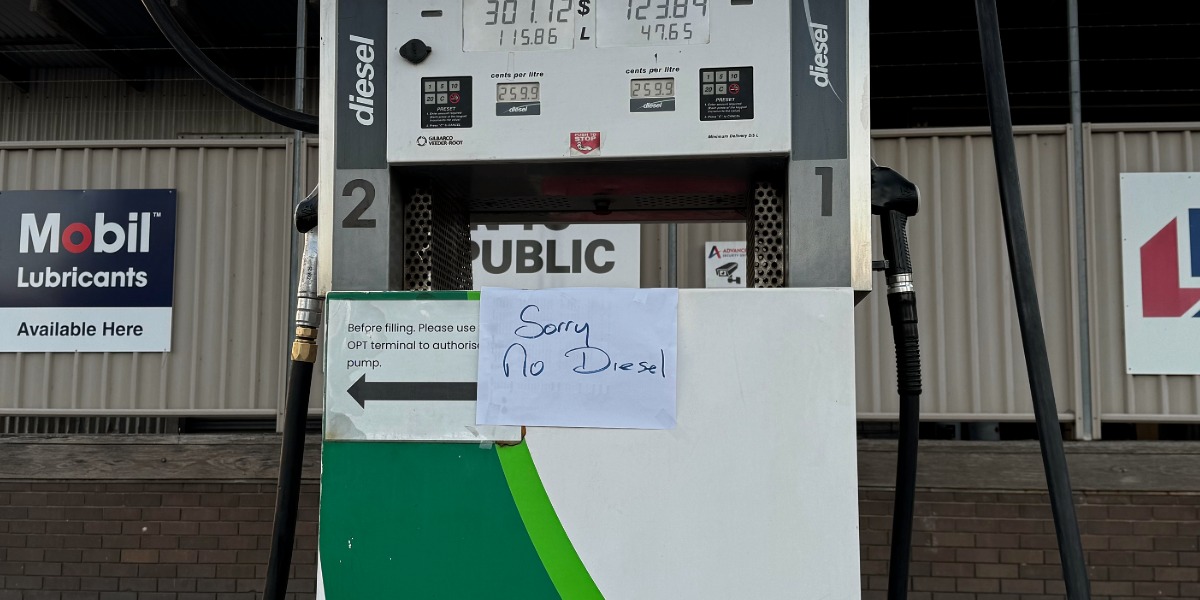
Animal welfare concerns are mounting across regional Australia as the federal government finally moved to ease fuel supply pressures that farmers say are threatening livestock transport, planting, and the daily operation of rural industries.
After days of doggedly insisting there was no problem, Energy Minister Chris Bowen announced in Parliament that Australia would temporarily relax fuel quality standards to allow an additional 100 million litres of petrol a month to remain in the domestic market rather than being exported.
The emergency measure will allow fuel with slightly higher sulphur levels to be blended into Australian supply for the next 60 days, with Ampol committing to prioritise that fuel for regions experiencing shortages and the wholesale spot market used by independent distributors.
“The Government’s focus is ensuring our fuel gets to where it needs to go,” Mr Bowen said.
“In order to assist with getting more supply and secure downwards pressure on prices, I am temporarily amending Australia’s fuel quality standards to allow higher sulphur levels for the next 60 days.”
“This will allow around 100 million litres a month of new petrol supply that would otherwise have been exported to be blended instead into Australian domestic supply.”
Mr Bowen said the redirected supply would be prioritised for “regions of shortage and for the wholesale spot market that supports independent distributors and harvesters”.
The move follows growing alarm from farm groups, fuel distributors, and regional politicians who say the current squeeze on independent fuel suppliers is already disrupting agricultural operations across rural Australia.
National Farmers’ Federation President Hamish McIntyre said farmers were increasingly reporting difficulty accessing fuel through independent regional retailers.
“While overall national liquid fuel supplies may remain sound, impacts are being acutely felt in regional communities right now, especially among independent retailers who rely on the ‘spot market’ for supplies,” Mr McIntyre said.
“This is seeing concentrated impacts on regional communities where independent retailers dominate, which is very different from metropolitan areas.”
Mr McIntyre said the situation was rapidly escalating from a fuel logistics problem into a risk for Australia’s food production system and carried serious animal welfare implications, particularly for industries reliant on daily feed deliveries and livestock transport.
“There are industries like dairy that need fuel to move product every single day,” he said.
“Farmers also need fuel to transport fodder to livestock and maintain the health of their animals.”
The fuel squeeze was also raised in Parliament this week by all of the North Coast’s federal politicians.
“The Dorney family in Bulahdelah run two timber mills, multiple hauling and felling crews, and a fleet of logging and freight trucks. In one week alone, their daily fuel costs have increased by $7,800,” Member for Lyne, Alison Penfold, said.
“Their supplier says the problem is not panic buying but fuel shortages at terminals and rationing between customers.”
Member for Page Kevin Hogan was particularly scathing of the government’s repeated denials of the issue.
“We all see times when we think and notice that governments have tin ears on issues and are not responsive to something important happening in our communities, but, indeed, this one is happening right across our nation,” Mr Page said.
“We’re talking about people who are feeding our country. We’re talking about trucking companies who need to transport food to our supermarkets.”
Member for Cowper Pat Conaghan called for immediate action to prevent bigger issues.
“I can tell you that right now the service stations at Nana Glen, Glenreagh, Bowraville, Boambee, and Coffs Harbour Marina have all run out of fuel or, in the case of the marina – and it’s a large marina with a cooperative that supplies seafood up and down the coast –have been told that their fuel supply is not guaranteed.”
“What we will see is job losses.”
“What we will see is that freight will not be able to deliver those goods to supermarkets.”
“What we will see is a shortage of food in supermarkets because of this government’s failure to actually make sure that the fuel gets out there,” Mr Conaghan said.
Industry operators say those kinds of concerns are becoming increasingly more likely as regional distributors struggle to secure supply and transport costs surge.
Denny Kreutzer, managing director of independent distributor Westlink Petroleum, said animal welfare was now their primary determinant of who gets fuel.
“We’ve got around 500 orders waiting and we can’t get enough fuel to do them all,” Mr Kreutzer said.
“So we’re having to make awful choices about who gets fuel first.”
“We’re prioritising feedlots and operations where animals will literally die if they don’t get fed. The grain guys who can wait a bit are being asked to wait.”
Mr Kreutzer said the situation highlighted the real-world consequences of the supply squeeze.
“When you’re deciding between a customer who can delay and a feedlot where stock will go hungry, the choice is clear,” he said.
“We’re making sure animals are looked after first, even in the middle of this fuel crisis.”
Kreutzer said the company had introduced a temporary 17.5 per cent fuel levy simply to cover skyrocketing operating costs.
“We didn’t pluck 17.5 per cent out of thin air. We sat down and worked out exactly how much fuel our trucks use and the kilometres they travel on each delivery,” Mr Kreutzer said.
“If anything, some of our bigger clients tell me we’re still a bit light.”
Mr Kreutzer said the levy was not about profit but survival as diesel costs soared.
“Our own fuel bill has effectively doubled – we’re talking hundreds of thousands of dollars more a month just to keep 38 trucks on the road,” he said.
“The 17.5 per cent levy simply covers the extra dollar a litre we’re being hit with. It keeps us operating without ripping anyone off.”
What do you need to know to get through the fuel crunch?
Tell us what information you need to make it through the fuel shortage crisis. Suggest a story!
Read other fuel crunch stories here.
Put your business in a story like this – find out more here.