

Local councils have few real tools to deal with a councillor who won’t behave. A script borrowed from Donald Trump and Pauline Hanson, turning every sanction into proof of persecution, is starting to make some council meetings impossible to run.
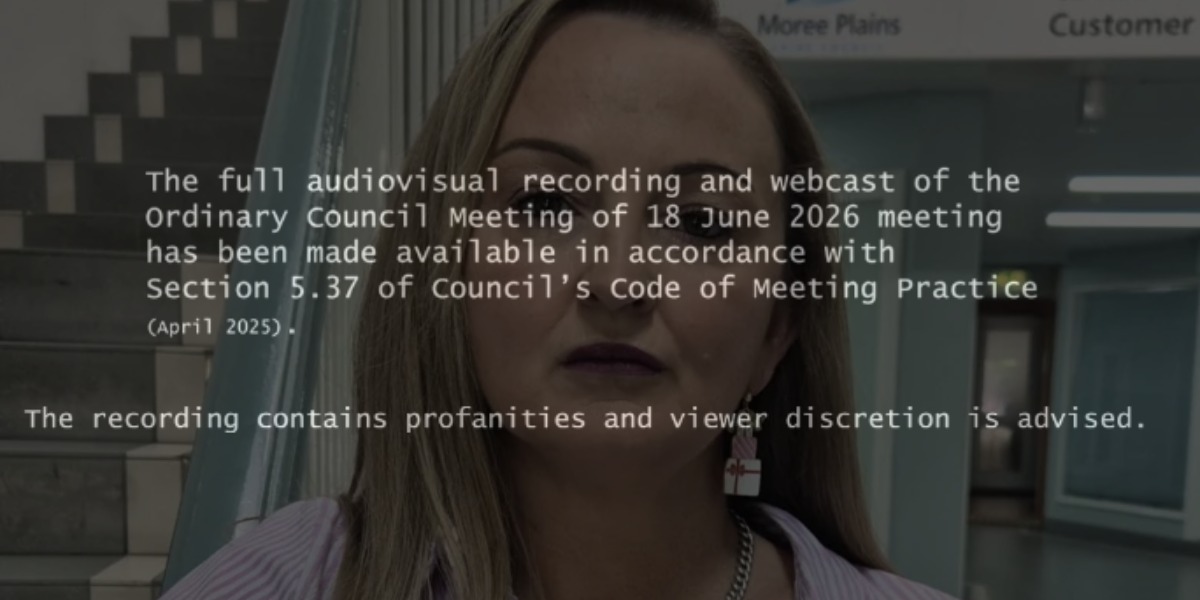
Disclosure: This story includes details of the behaviour of Moree Plains Shire Councillor Kelly James and disciplinary action taken against her. Cr James has previously initiated defamation proceedings against this masthead for publishing in 2024 the fact that she had been censured by Council. It is never defamatory to fairly report matters of public interest and public record under the public documents exception. Great care has been taken to ensure that everything in this article is a matter of public record, with videos and documents linked as much as possible.
Councillors, it’s been a long day
More than three and a half hours into the five-hour June meeting of Moree Plains Shire Council, Deputy Mayor Wayne Tighe had had enough.
“I’ve actually had enough today. I’ve actually really had enough.”
The 48-year-old had taken the chair half an hour earlier, to relieve an exhausted Mayor Susannah Pearse. Just seven months before that, he had become the first Aboriginal person to chair a council meeting in Moree. That day, he probably wished he hadn’t put his hand up to lead.
“The whole community is watching us,” he said. “We are the laughingstock of this town.”
“I don’t care,” said Cr Kelly James.
“The community doesn’t want this behaviour,” Deputy Mayor Tighe said.
Cr James had just raised her voice at her colleagues. It was not the first time in that meeting, and it would not be the last.
Less than 15 minutes later, after another outburst, Cr James was expelled from the meeting. It wasn’t the first time, and it would not be the last.
The victimhood playbook
The global rise of populist politics has been matched by a decline in decorum by politicians across the world, many posturing themselves as the victims of the system to boost their credibility of being on the side of the people.
Pauline Hanson has been perfecting this play for three decades. She frequently casts herself as an ordinary person under siege from an out-of-touch establishment, so every rebuke becomes another chapter in that story rather than a reason to reconsider her conduct.
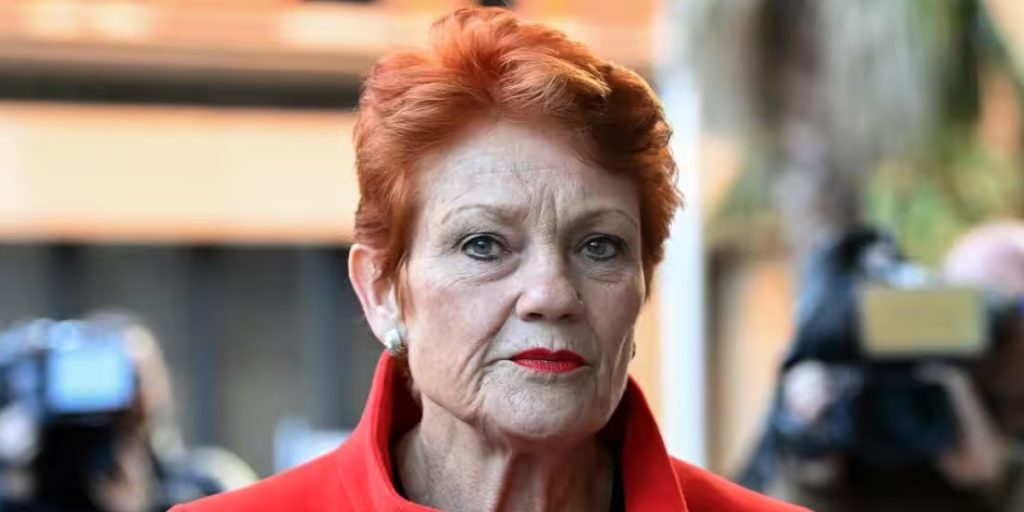
University of Newcastle researcher Kurt Sengul has traced Hanson’s “politics of victimhood” back to the start of her career. He argues she builds it on two fronts. She presents herself as a victim of the political elite, while casting “the people” as endangered by elites conspiring with minorities to strip them of their culture and standing. In 1996, she told Parliament that “the most downtrodden person in this country is the white Anglo-Saxon male.” In 2018, she moved a Senate motion declaring “it’s OK to be white”.
Donald Trump runs the same play at global scale. The more he is investigated or fact-checked, the more his supporters treat it as proof he is being targeted. Jessie Barton Hronešová and Daniel Kreiss call this “hijacked victimhood”, a strategy in which politically dominant figures cast themselves as oppressed, inverting who actually holds power. Writing about Hungarian prime minister Viktor Orban and Mr Trump, they argue it works to “strategically invert moral relations and subvert empirical understandings of harm,” making it harder for people who are genuinely marginalised to be heard.
Mark Kenny, a professor at the ANU’s Australian Studies Institute, sees the same pattern closer to home. “On the populist right, an eruptive victimhood is central to both identity and strategy,” he wrote. London School of Economics media scholar Lilie Chouliaraki, whose book “Wronged” examines what she calls the “weaponisation of victimhood,” argues the claim has become a tool of the powerful rather than the powerless. “Victimhood is complicit with power,” she said, “how it is appropriated as a linguistic weapon of the already privileged to gain even more power.”
The censure, a formal condemnation of actions or behaviour and the strongest rebuke most parliaments can offer against one of its members, has also been turned into a source of populist power. Pauline Hanson was censured twice by the Senate for her inappropriate comments against Muslims in the last year. Each time she used it to boost her popularity, broadcasting it to her followers and deriding it as a ‘joke’ and ‘stunt’ by ‘dark forces’ that were ‘shouting her down’.
The most challenging part of this behaviour, and the main reason it is increasing, is that social media algorithms reward it. A politician who is criticised or sanctioned can post about it within minutes, framing the process itself as the injustice, before anyone else has had a chance to explain what happened. The angrier the backlash, the more convincing the victim narrative becomes to an audience that was never going to read the underlying finding anyway.
This challenging pattern is becoming increasingly common in local government. Whether by accidental impression, or consciously inspired by their populist heroes, politicians both aspiring and current are deploying the victimhood playbook to great effect.
A system with almost no teeth
Every NSW council must adopt a code of conduct based on the state’s Model Code of Conduct for Local Councils. A written complaint about a councillor normally goes to the general manager, or the mayor if the general manager is the one being complained about, within three months of the alleged conduct. An independent conduct reviewer can dismiss it as trivial or vexatious, or investigate further.
If a breach is confirmed, the strongest sanction a council can impose on one of its own is a formal censure, a public reprimand with no legal force.
The investigation progress is also completely secret. No one, not the council, nor the Office of Local Government (OLG), will even confirm that an investigation is underway. The report is considered in closed council sessions, and the first the public knows of it when the final outcome is recorded, often with little explanation of the conduct that triggered the investigation.
The whole cycle typically takes around six months, and can cost a stretched council tens of thousands of ratepayer dollars in investigator fees, for an outcome that delivers little beyond its intended message of disapproval. A censure carries no legal consequence, and there is no penalty for a councillor who ignores it.
That six months of required silence gives the individual accused of a code of conduct breach plenty of time to frame the narrative, most commonly through long social media posts detailing how they are the victim.
For anything more serious, the matter can be referred to the OLG. Its own strongest option, imposed by the Departmental Secretary rather than a court, is to suspend a councillor for up to three months. The councillor keeps their seat and simply cannot exercise its functions, or draw its fees, for the period of the order, under section 440K of the Local Government Act.
If the OLG suspends a councillor for three months, three times, the councillor becomes disqualified from being a councillor for a period of five years.
No one – not a mayor, not a general manager, not even the Minister for Local Government – can sack an individual councillor outright. Only a whole council can be dismissed, and only after a formal public inquiry, a process reserved for systemic governance and administration failures far broader than one disruptive member.
A spokesperson for the OLG said councillors are expected “to uphold the high standards rightly expected of them by the community and demonstrate the decorum befitting their civic office.”
“Being a councillor is a privilege and there is no place for conduct that undermines the proper functioning of a council or diminishes public confidence in local government.”
Same script, different council
There are examples of victimhood posturing in a number of councils across the state, each time with a similar play: councillor does wrong, code of conduct investigation finds wrongdoing did occur, councillor frames finding as part of a conspiracy against them or ‘not telling the full picture’ in a long-winded social media post, and the end result is that their popularity increases.
In Tamworth, Cr Mark Rodda was formally censured in March 2025, after a Facebook post he made in August 2024 attracted a wave of negative comments, one likening council staff to Nazi propagandists. Tamworth Regional councillors found he had breached several sections of the code by failing to moderate the comments on his own post. He dismissed the censure as ‘vindictive’ and his colleagues as a ‘cabal’.
“With hindsight I guess we could always do things better, but I fear the motivation behind actions like this is to quell and suppress my voice,” he told the Northern Daily Leader at the time. “If they think this will actually do that, then they’re wrong.”
The matter was referred to OLG which ultimately took no further action. In a letter, it told him the censure “should serve as a deterrent, demonstrating that inappropriate conduct on social media will not be tolerated”, and warned that further action could follow if he continued “to engage in similar conduct.” Cr Rodda thanked his supporters, telling them the news “truly warms the cockles of my heart.”
In Glen Innes, an investigation into former Glen Innes Severn Council Cr Troy Arandale reached council in December 2025, finding he too had breached the code. Arandale dismissed the process repeatedly as a “witch hunt“. By the time the matter was resolved, Arandale had resigned from council.
The next case brewing is at Tweed Shire Council, which voted to expel Cr Kimberley Hone in July over comments about issues with the Northern Regional Planning Panel. When she refused to leave, police were called. The removal was filmed and posted to social media by Member for New England Barnaby Joyce, showing her telling followers it was because “we are no longer allowed to say what we think or feel.”
Pauline Hanson and Vikki Campion in the Daily Telegraph amplified the incident, casting the ejection as the silencing of a dissenting voice rather than the enforcement of a meeting procedure.
Hone has since repeatedly posted to social media about how she will not be silenced. She has another five or so months to keep doing so unchallenged before the slow council code of conduct process will likely deliver a censure.
This intense publicity of the former Nationals Candidate for Richmond’s disorder appears to have fuelled what happened in the August Moree Plains Shire Council meeting.
Censured three times, and still going
Cr James’ pattern of behaviour within the chamber has been building since before the last election in 2024. Her first censure was delivered in the last meeting of the last term, and was not widely reported.
After the 2024 election, James unsuccessfully stood for Mayor, losing to Susannah Pearse in October. Two months later, Cr James moved a motion of no confidence in the newly elected mayor. It failed spectacularly, with James the only councillor to vote for it. Even her own seconder, Fred McGrady, withdrew his support before the vote, saying the motion had shifted from “a matter of transparency” into “a personal, vindictive, battle.”
In a spiral of rapidly declining behaviour over the last six months, two more censures followed in May and July this year. She has also been expelled from council meetings in February, March, June, and August 2026. Only one meeting this year, in April, has passed without Cr James being expelled or censured.
The personal attacks on Mayor Pearse have continued as a theme in Cr James outbursts.
In the 5 February meeting, as the debate declined and the council moved to expel her, James said: “You do anything you possibly can to have me removed Susannah, because you are so threatened by me it’s ridiculous.”
In the June meeting, as she was expelled, Cr James turned on Mayor Pearse again. “You better fucking do it. You fucking psycho fucking bitch. You push me over,” she said, before the chamber’s video stream cut out.
Following similar scenes in the most recent meeting on August 20, Moree Plains Shire Council moved to expel her from that meeting too. This time, however, she refused to go, demanding that police be called, so she could film the confrontation “like old girl”, referring to Tweed councillor Kimberley Hone, and send it to 2GB radio host Ben Fordham.
Cr James started livestreaming to Facebook while still in the chamber. The first 14 minutes of the 18 minute live stream is largely uneventful with James sitting and waiting for the police. She can be heard telling fellow councillors and police that they should “understand what’s coming for them.” She referenced a 50-page complaint and warned she was “taking legal action against every person in this room.”
Fellow councillor Fred McGrady and a council staff member can be heard pleading with her to leave, while Cr James continues to incite dispute with her colleagues.
In the council lobby, again waiting for police who were never coming, she unleashed an expletive-laden tirade caught on the same livestream.
“The police are taking too long, and they want to finish their meeting, so I’ve gotta go,” she said.
“You know what? Fuck it. Everything that I know about this fucking shitshow of a place is gonna come out, and I don’t give a fuck who is upset about it.”
“Because you know what? Being born and bred in a fucking town that you can never get any fucking action on because you have to deal with a bunch of fuckwits is great.”
She turned her anger on the state government next.
“Might just give the Minister a call and ask him how much of a fucking wanker he is, because obviously his fucked up shit doesn’t get dealt with,” she said, before reconsidering.
“Actually, you know what? No, call the fucking police. I don’t care. Where are they? They obviously don’t give a fuck about this. They’ve got more crime to worry about than fucking Kelly James being in the fucking chamber because they don’t want to hear the fucking truth.”
Then, almost as an aside: “I have been censured twice, and I’m gonna be censured again. Pity, I don’t give a fuck.”
By the council’s count, Cr James has been censured three times: on 18 July 2024, 21 May 2026, and 16 July 2026. By her own count, only two censures stand, because she disputes the legitimacy of the third.
No police came that day. (Police attended previously, on 5 December 2024, to remove her from the Council building after she was evicted from an extraordinary meeting.) NSW Police confirmed officers did not attend the meeting and that no charges were laid, declining to comment further.
The NSW Minister for Local Government Ron Hoenig and the NSW Minister for Police Yasmin Catley also declined to comment.
Cr James did not respond to a request for comment, and a specific question as to why she insisted police be called, sent to her council email.
Suspended three times, still going
Cr James does not, however, hold the mantle of NSW’s most disruptive current councillor. That record belongs to Cr Andrew Thaler of Snowy Monaro Regional Council.
The long-term maverick politician and serial candidate from Nimmitabel has, not unlike Hanson herself, had a resurgence in popularity fuelled by extensive social media activity. He managed to get a seat on council with just 111 primary votes in 2024. Ironically, the high-profile coverage of his problematic behaviour and persistent abuse, predominantly of women, may have helped his campaign.
He has been suspended from office three times since May 2025, each time for three months, the maximum penalty available to the OLG.
The first, in May 2025, followed a Departmental Report into online comments about named individuals, and came with an order to publish a written apology within 14 days.
It did not stop him. A second suspension, ordered in July 2025 over further social media posts, carried the same requirement.
The third, ordered in October 2025, found sixteen breaches. Fifteen were for offensive comments about council staff and colleagues, naming seven people including four fellow councillors, which investigators found “occurred in a public forum, and in such circumstances that appear to be targeted and intentional.” The other was for failing to comply with the earlier apology order.
Under the Local Government Act, three misconduct suspensions are supposed to trigger automatic disqualification from civic office for five years. Cr Thaler has not been disqualified. He remains a councillor today, because his second suspension order was successfully challenged on appeal. NCAT confirmed the misconduct but substituted a formal reprimand for the suspension. With only two suspensions technically standing rather than three, the automatic disqualification never applied.
He served his third suspension between February and May 2026, once the appeal process had run its course. He returned to the chamber on 24 May 2026, entitled, as the council put it in a public notice, “to resume exercising the functions of the office of councillor.”
The extensive disciplinary actions appear to have had no impact on his behaviour, either within or outside of council.
In June, he faced court over deliberately ramming a neighbour’s car. During proceedings, his own lawyer is reported to have joked that the number of apprehended violence orders involving Cr Thaler and his neighbours “may be an Australian record”.
He has set another record, being the first ever councillor to face an application for a “Stop Bullying Order”, lodged by the Development and Environmental Professionals Association, the union acting on behalf of Snowy Monaro Council’s CEO Noreen Vu. In Council’s response to the claim, they detailed how Cr Thaler was banned from council buildings, ordered to cease and desist his behaviours that were considered a workplace risk, and multiple other measures to deal with the issue.
“Censure under the code of conduct is clearly not a disincentive to Cr Thaler,” the statement says.
“Cr Thaler continues to undertake the same behaviour.”
Reforms underway, but for a different problem
The state government knows the code of conduct system is not working, though it has a different diagnosis in mind. The reform push was first flagged in a September 2024 consultation paper, then announced in Tamworth in November 2024. Minister for Local Government Ron Hoenig did not mince words about what he thinks is broken.
“The current councillor code of conduct system is fundamentally broken,” he said.
“It is too open to weaponisation, with tit-for-tat complaints diverting critical council resources and ratepayer money from the things that matter most to communities.”
The “sheer volume of vexatious complaints,” he said, was “preventing the Office of Local Government from focussing its attention on getting crooks out of the local government sector.”
Criticised for focusing too much on peripheral concerns, like requiring all to stand when the Mayor enters the chambers, the 2025 Model Code of Meeting Practice was disallowed by the NSW Legislative Council in May. The main reasons the upper house voted to disallow the bill is that requirements to attend all meetings in person, and prohibiting private briefings and meetings between councillors or with council staff, proved unworkable.
While that code goes back to the drawing board, a regulation has been put in place which keeps the most important reforms: requiring councils to livestream and archive meeting recordings, and allows a councillor who fails to remedy disorder to be expelled from successive meetings until they comply. The rest of the code of meeting practice has reverted to the 2021 version.
In June, the OLG released a new draft Model Code of Conduct for consultation. It proposes letting complaints go directly to the OLG, rather than a council’s own general manager, and a new public interest pathway to speed up serious cases. For serious misconduct, it would also replace the NSW Civil and Administrative Tribunal with a pathway to the Land and Environment Court.
The proposed framework would also define “unsatisfactory councillor behaviour,” to be assessed by a panel of mayors and councillors with more than two terms of experience. Alongside it sits a more serious category, “Serious Misconduct,” which the OLG itself would investigate, tied to breaches such as conflicts of interest.
Read against the histories of the likes of Cr James and Cr Thaler, though, the reform agenda is aimed at a different problem. It targets councils where factions weaponise the complaints process against one another, filing complaint after complaint over political disagreements rather than genuine misconduct. Mr Hoenig’s language, of weaponisation and tit-for-tat filings, describes warring colleagues wearing each other down with paperwork. It does not describe nor deal with a single disruptive councillor whose behaviour is, in any context, highly inappropriate or abusive.
The Office of Local Government says that social media use by councillors is in its sights as part of the reforms.
“The NSW Government is also progressing reforms, including a new public interest pathway for faster action against councillors breaching legislative obligations, a draft new Model Code of Conduct to strengthen councillor accountability, improve councillor conduct and restore faith in our councils. The draft Code updates conduct standards to address contemporary issues facing councils, including the use of social media,” a spokesperson said.
The draft does not, however, propose any tool that may be able to deal with the victim posturing that turns every disciplinary measure into populist social media fodder.
The price we all pay
The cost of this increasing trend of intentional disorder to build popularity on social media is borne by all ratepayers. Aside from the high literal cost of code of conduct investigations, the toxic work environment results in high staff turnover within councils, and competent and capable people being discouraged from running for council. Particularly women, who shoulder a disproportionate amount of abuse from both fellow councillors and members of the public.
In August, Local Government NSW pointed to a Women for Election survey about exactly this problem. It found 89 per cent of Australian women in public office, or seeking it, had experienced online abuse, with half saying they had considered leaving public life altogether. LGNSW director Cr Romola Hollywood said the findings “should alarm anyone who cares about the future of local democracy,” calling it “a systemic threat to democratic participation.” Most of that abuse comes from the public rather than a colleague, but it points to the same gap: a system with no dedicated framework to protect the people inside it.
Compounding the issue, councillors are not considered “workers” under NSW work health and safety law. The psychosocial protections that apply to an employee facing sustained abuse from a colleague do not apply to a fellow councillor or a mayor. Although SafeWork NSW can and do investigate – including a current investigation of councillor-on-councillor bullying at Hawkesbury council – they too have no mechanism to remove an abusive councillor from council.
New England Times understands some staff of Moree Plains Shire Council have been given permission not to be in the chamber. It is not an option available to elected councillors.
As the reform process progresses there is only one certainty: it will be slow.
And in the meantime, councils are being disrupted right across the state, with no real tools to deal with it.
Like what you’re reading? Support North Coast Times by making a small contribution today and help us keep delivering local news paywall-free. Donate now