

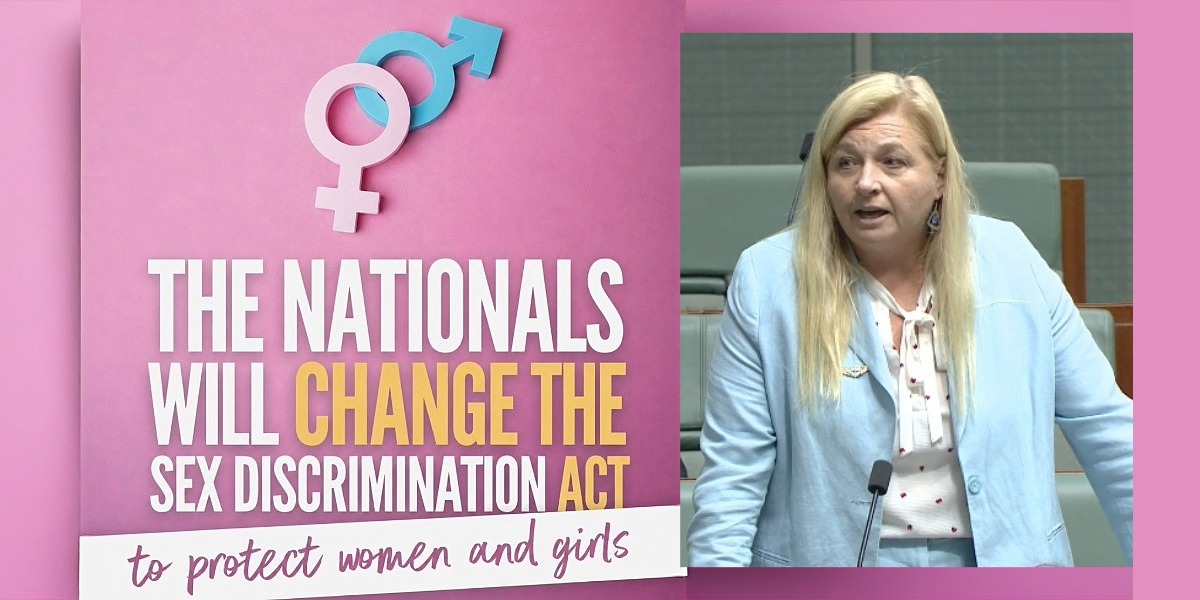
Federal Member for Lyne Alison Penfold says the timing of her controversial sex discrimination bill and the landmark Giggle v Tickle judgement was “just a coincidence”, revealing she has been working on the legislation for months and had no idea when the Federal Court decision would be handed down.
Ms Penfold is preparing to introduce the Sex Discrimination Amendment (Sex-Based Rights) Bill 2026 to Parliament on Monday, with a draft of the legislation expected to be released as early as today.
Largely an act of political compromise to give legislative clarity, the bill seeks to reintroduce definitions of “man” and “woman” into the Sex Discrimination Act, and clarify that where there is a legal conflict between biological sex and gender identity, biological sex should prevail – but not, as many assume, strip rights from non-binary or trans people.
The bill comes amid heightened national debate after the Federal Court upheld a ruling that transgender woman Roxanne Tickle was unlawfully discriminated against when removed from the Giggle for Girls app. But Ms Penfold said the overlap in timing was not intentional.
“Timing-wise, I’ve been working on the bill for several months,” she said.
“The bill itself has been on the notice paper for six weeks. I didn’t actually know that the Giggle versus Tickle case was being handed down, so this is a coincidence, or divine intervention, whichever way you want to look at it.”
Ms Penfold said she first committed to introducing the legislation during her preselection campaign before the 2024 federal election, after Nationals members in Lyne passed motions calling for biological definitions of male and female to be restored in law.
“I made a commitment to the members of the National Party in the Lyne electorate when I was pre-selected, and before that, that when members put up a motion to do exactly what I’m doing, I made a commitment I would do it — and I am,” she said.
“I think integrity in politics does matter.”
The legislation seeks to restore the simple definitions of man and woman originally contained in the 1984 Sex Discrimination Act, but removed in a raft of legislation pushed through by the Gillard Government that sought to extend equality and protections to LGBTIQ Australians while actively denying them the right of same sex marriage.
“‘Man’ means a member of the male sex, irrespective of age,” Ms Penfold said. “‘Woman’ means a member of the female sex, irrespective of age.”
But Ms Penfold insists the legislation, which is very unlikely to pass as a private members bill, is not part of a broader push to strip transgender Australians of anti-discrimination protections, distinguishing her proposal from previous attempts made in the Senate and the motion passed at the NSW Nationals conference in 2024.
Sex Discrimination Act 1984
That Conference calls upon The Nationals in government to reinstate the definitions of “sex”, “male/man” and “female/woman” — removed by the Gillard Government in 2013 — into the Sex Discrimination Act 1984, and remove the term “gender identity” from the legislation. Language of a motion passed at the NSW Nationals conference in 2024. The private members bill does not seek to remove the term gender identity.
“There’s a very important distinction between my bill and previous bills that have been introduced in the Senate on this, in that I am not repealing the definition of gender identity,” she said.
“In fact, my bill does amend the definition of gender identity, but it isn’t seeking to remove it as a protected attribute — and that’s really important.”
The bill also does not remove the term intersex, nor strip protections for intersex Australians, but does seek to change the definition in a manner likely to upset both sides of the debate. The proposed definition of intersex reads: “Intersex status means the status of having genetic or hormonal differences of sexual development, which are often expressed in anatomical sex characteristics that are atypical for that person’s sex.”
Ms Penfold acknowledged the legislation would reduce some rights currently available to transgender Australians, but argued women had lost rights under the current interpretation of the law.
“I know that I’m limiting rights for transgender Australians, but right now women don’t have a choice,” she said. “And I want to give choice back.”
She said the bill was designed specifically to address situations involving women-only spaces, services and activities, and argued the current Sex Discrimination Act lacked a clear balancing test when rights based on biological sex and gender identity came into conflict.
“The court has come down on that — that gender identity trumps biological sex,” she said.
“Well, that leaves young women having to accept men who identify as women in female spaces.”
Ms Penfold rejected accusations the bill was motivated by hostility toward transgender Australians, and said the legislation would not prevent inclusive spaces being created.
“My bill does not prevent somebody establishing an app for women that includes transgender women,” she said. “I’m just simply making sure that women have a choice.”
The unexpectedly intense debate over the bill comes as Ms Penfold rapidly builds a profile as one of the Nationals’ most active new MPs. Ms Penfold has another private member’s bill on the notice paper next week relating to compensation for the timber industry over the impacts of the Great Koala National Park proposal. In recent weeks she has also spoken in Parliament on issues ranging from regional roads and telecommunications to fuel prices, housing affordability, women in defence, the Rural Fire Service, the NDIS, health services and the federal budget.
Despite the fierce reaction already emerging around the proposed gender legislation, Ms Penfold said she believed many Australians supported what she described as a “common sense” position.
“People do care about the safety and the privacy of women and girls,” she said. “They simply want common sense to prevail.”
Read all the way through to the end of the story? So did lots of other people. Advertise with North Coast Times to reach locals who are interested and engaged. Find out more here.