

Australia is on the cusp of generating half its electricity from renewable energy, and the households driving that shift are exactly the kind of solar-savvy communities that make up the North Coast.
The Australian Energy Market Operator released its 2026 Integrated System Plan on Thursday, the most comprehensive long-term roadmap ever produced for the National Electricity Market. It confirmed what many North Coast households have already figured out for themselves: rooftop solar and home batteries are changing everything.
Nearly half of Australia’s electricity came from renewable sources in the last financial year, with the share fast approaching 50%. Around 36% of detached and semi-detached homes now carry rooftop solar, and approximately 600,000 households have home batteries. The plan projects rooftop solar will quadruple by 2050.
“Over the forecast period, Australia’s ageing coal-fired power stations will close while electricity consumption is forecast to nearly double,” said AEMO CEO Daniel Westerman.
“At the same time, consumers are continuing to invest in rooftop solar and home batteries, which benefits all consumers by reducing the need for grid-scale investment,” he said.
The plan was shaped by close to 2,000 stakeholders and more than 300 submissions, and tested around 1,000 different combinations of investment across three future scenarios.
The federal government timed its own announcement to coincide with the ISP release, revealing 15 large-scale batteries funded under the Capacity Investment Scheme, enough collectively to power 3.7 million Australian households. The projects span New South Wales, Queensland, Victoria, and South Australia.
Clean Energy Council Chief Executive Officer Jackie Trad said the scale of the task ahead was significant but achievable.
“To replace retiring coal plants and meet rising demand, Australia needs to roughly triple its build of large-scale renewable generation and storage. That’s what keeps the system reliable and keeps a lid on costs as coal leaves,” Ms Trad said.
“Households are already part of the solution. Rooftop solar is set to quadruple by 2050 and home batteries are taking off. But that investment only pays off for everyone if the grid can actually use it.”
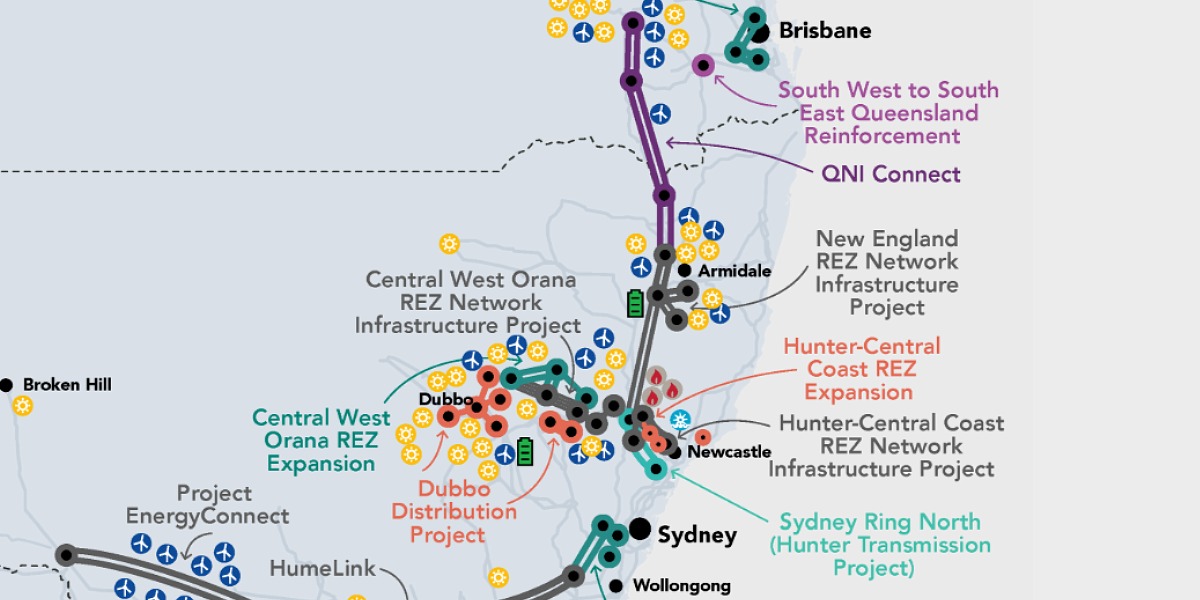
That means new transmission lines, 6,000 kilometres of them nationally, which the ISP says would save consumers $30 billion compared to a pathway without them.
National Director of the Renewable Energy Alliance, Andrew Bray, said communities hosting new infrastructure deserved a genuine say and fair compensation.
“We need to focus on what can be done to better support these communities and ensure governments start making serious investments in robust, community-led solutions,” Mr Bray said.
The ISP’s insistence on transmission as essential infrastructure stood in stark contrast to an announcement by the NSW Coalition on Wednesday to scrap a key 500-kilovolt transmission line in the New England region.
Ms Trad said the building phase was now the critical challenge.
“The plan is clear about what to build. The job now is to build it at a pace to replace coal generation in an orderly manner. Right now, there’s a gap between projects being financed, getting built, and connecting to the grid. Closing that gap and getting transmission moving is what stands between this plan and lower, more reliable power for Australian homes and businesses.”
The 2026 ISP report is available at aemo.com.au.
Advertising with North Coast Times is a cost effective and reliable way to reach locals who are interested and engaged. Find out more here.