

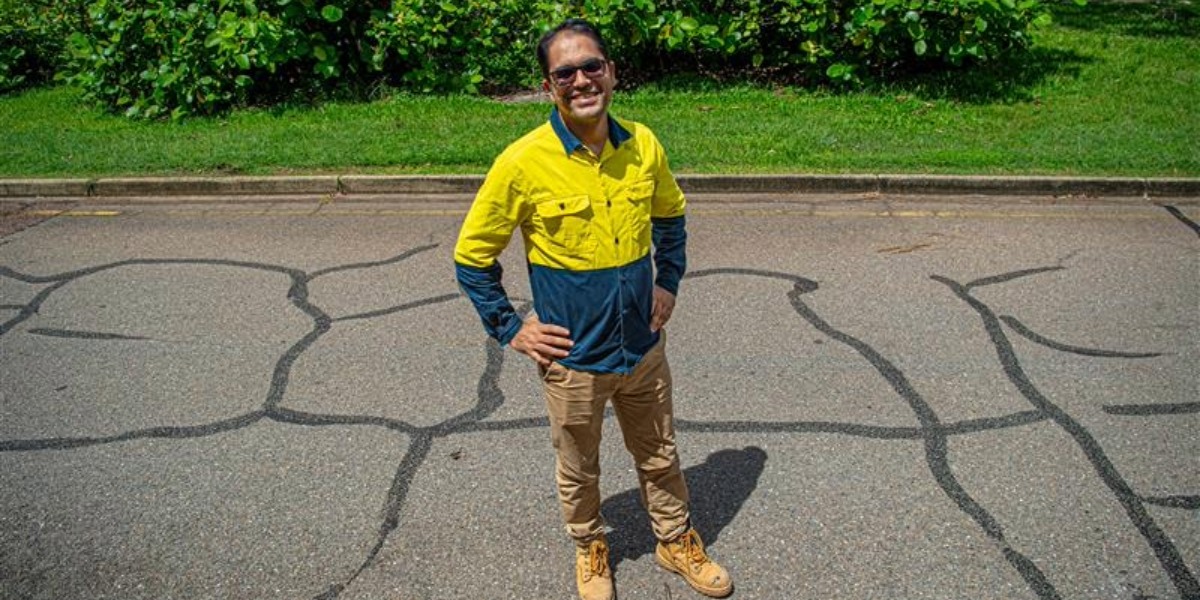
MidCoast Council is one of a select few councils across the state chosen for a Transport for NSW trial fitting AI cameras to its rubbish trucks to hunt down potholes before they get out of hand. Now, researchers in Darwin are working on the next step: a robot that could find a crack and fix it on the spot, before it ever turns into a pothole.
But while MidCoast’s waste trucks can spot the damage, they cannot fix it. That is where a new $1.2 million partnership between Charles Darwin University (CDU), Civiltech Solutions and the Additive Manufacturing Cooperative Research Centre (AMCRC) comes in, combining LiDAR road scanning, artificial intelligence, robotics and additive manufacturing to detect and repair cracked roads with minimal human involvement.
CDU’s Centre for Asphalt and Road Technologies (CART), which received half a million dollars in funding as part of the partnership, is contributing expertise in robotics, materials engineering and additive manufacturing to build on Civiltech Solutions’ existing LiDAR-based road scanning platform.
CART Director Dr Ali Rajabipour said the project was still in its early stages.
“We are in the phase of crack detection and then integration of these systems,” Dr Rajabipour said.
“The LiDAR technology, and the company offering that system to us, has a track record in that business for quite a while. For crack detection, most of the problem has been solved and properly investigated. The matter now is integration of the systems.”
Dr Rajabipour said Civiltech’s scanning system was already used commercially, including in Darwin.
“The normal practice is you see the cracks visually, and then there is a wand, and you spray a bit of cement over it, which is called crack sealing,” he said.
“But the proper process is you scan the road, you prioritise which crack is more critical, and then you manage the amount of material and select the right material for that. If you want to do that process with humans, it takes ages. With this AI and laser scanning, you can do it much, much faster.
“The AI system recognises the cracks, and then the robot reaches that crack, looks at it closely, and then sprays the right amount of material at the right rate.”
If the AI found damage too severe for a robot to handle, Dr Rajabipour said that task would fall back to Civiltech’s existing scanning and reporting service, which flags critical defects so road authorities can send out a crew.
He said the system could classify cracks by how far advanced they were, right up to a final stage known as a “crocodile crack”, so named because the cracking forms a pattern of interlocking squares. Most potholes start out as cracks, he said, when water gets in and washes away the loose material underneath the surface until it collapses.
Civiltech Solutions founder and chief executive officer Leigh Carnall said the project represented a major step toward modernising road maintenance.
“Road maintenance is still largely manual and reactive,” Mr Carnall said.
“By combining AI, robotics and advanced manufacturing, we can detect defects earlier and repair them with far greater precision, helping road authorities maintain networks more efficiently.”
Additive Manufacturing CRC managing director Simon Marriott said the project showed how the technology could be applied well beyond the factory floor.
“This collaboration highlights how industry and research organisations can work together to develop scalable solutions that improve productivity, sustainability and capability across Australia’s infrastructure sector,” Mr Marriott said.
Got something you want to say about this story? Have your say on our opinion and comment hub, North Coast Times Engage