


Southern Cross University researchers have landed the university’s first-ever Gates Foundation grant, and they plan to use it to halve the cost of a key supplement for pregnant women.
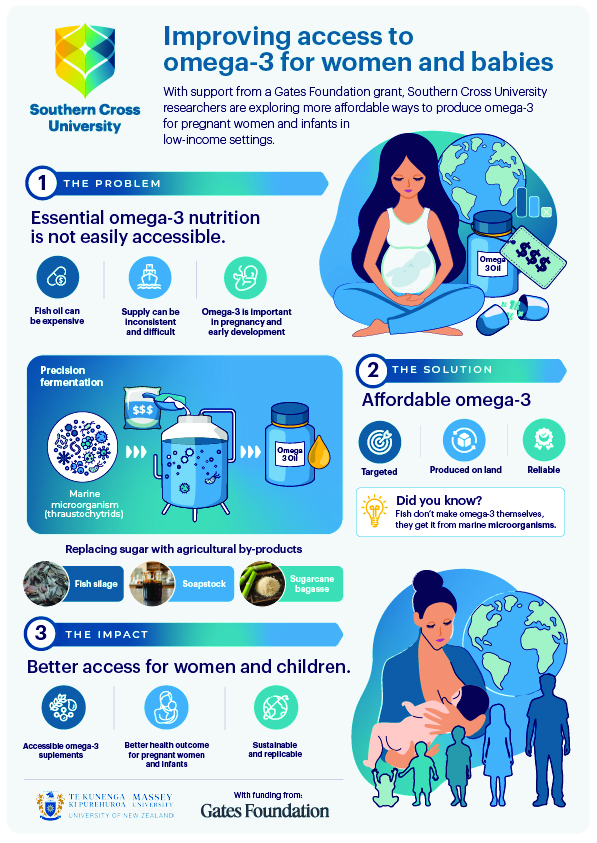
The 18-month project aims to cut the cost of omega-3 supplements for pregnant women and infants in low-income countries by at least 50 per cent.
The team will use precision fermentation of thraustochytrids, microscopic organisms nicknamed “throstys”. They will grow them on agricultural and food-processing by-products.
The project is called ‘Low-Cost DHA Production Using Porous Membrane Bioreactors and Agricultural Residues’ and is part of the Gates Foundation’s Grand Challenges.
DHA, a type of omega-3, builds up in the brain and retina during the third trimester. Around one in 10 babies is born preterm each year, missing out on some of that build-up.
Professor Dirk Erler leads the team, which also includes Dr Nedeljka Rosic, Dr Shane McIntosh, Dr Jasmine Haskell, and PhD researcher Michael Ingram. Professor Munish Puri of Massey University is also taking part.
“The main barrier for the uptake of omega-3s as supplements in pregnant women is the cost,” said Professor Dirk Erler.
“The whole objective of our project is to reduce that cost and make omega-3 supplements more available.”
Professor Erler said growing the organisms on land offered another way to produce omega-3s.
“By growing those microorganisms on land through precision fermentation, we have an alternative way of producing omega-3s that is both reliable and highly targeted,” he said.
Dr Rosic said the funding was a career highlight.
“As a biomedical scientist, my purpose is to find ways to use science to improve people’s health,” said Dr Nedeljka Rosic.
“Being funded by The Gates Foundation for such a project is an incredible honour.”
Professor Puri said he was excited about what the project could achieve.
“I’m genuinely excited about this project and its potential to make omega-3s more affordable and accessible,” said Professor Munish Puri.
Something going on in your part of the North Coast people should know about? Let us know by emailing newsdesk@nctimes.com.au