


A blueberry farm and the earthmoving contractor who dug its dam have been hit with a combined $130,000 in fines, after a judge found the decision to build the unapproved dam on sensitive waterfront land at Bucca, near Coffs Harbour, was reckless and made on the spur of the moment.
Blueberry farm owners Harpreet Pannu and Satvinder Pannu pleaded guilty in the NSW Land and Environment Court to constructing a water supply work without approval and carrying out unauthorised works on waterfront land, known as controlled activities. Together, the Pannus will pay $100,000 in fines. Earthmoving contractor Murray Gray was fined $30,000 for the same offences.
All three will also have to cover the Natural Resources Access Regulator’s (NRAR) legal costs.
The offences happened at Bucca between December 2022 and May 2023. In building the dam, the defendants cleared more than 1.8 hectares of vegetation, including native plants, which had the potential to affect the local koala population.
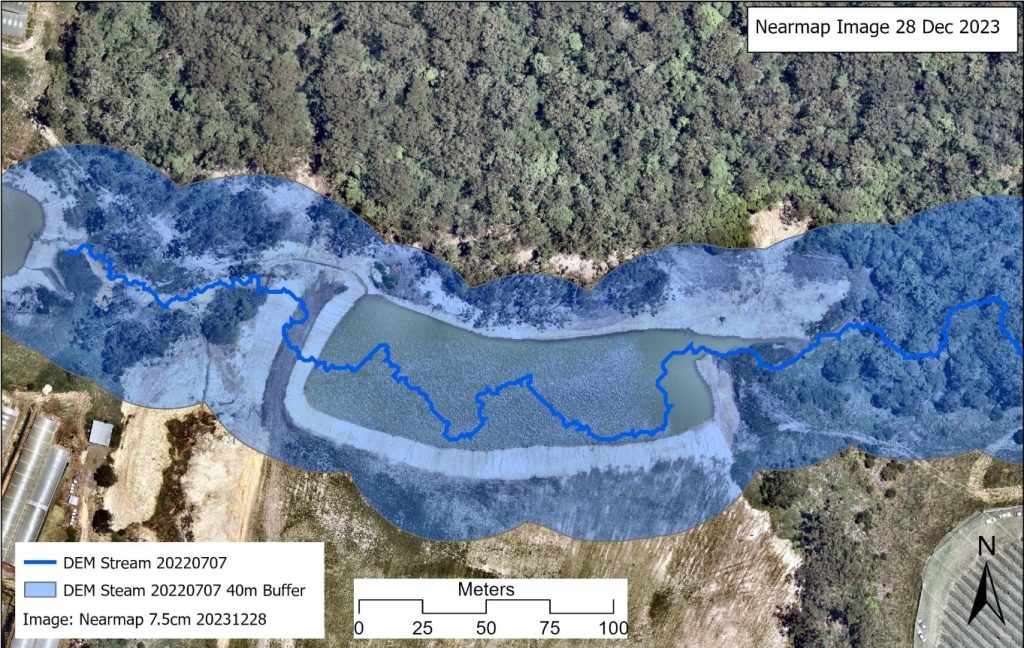
Justice Richard Beasley found the decision to build the dam was reckless, made quickly and on the spur of the moment.
NRAR Director Investigations and Enforcement Tim O’Connell said the penalty handed to the Pannus started out much higher.
“The initial fine was actually $60,000 each per offence, and then after the fact that they pled guilty at the first occasion, they get a discount of 25 per cent,” Mr O’Connell said.
The judge also took into account that the pair are a married couple who will share the financial burden of the fine, cutting the total from $240,000 plus legal costs down to $100,000.
“That’s not anything for us. That’s a matter for the court to decide on what the appropriate penalty is,” he said.
Mr O’Connell said NRAR weighs up four factors when deciding how far to pursue a case: culpability, harm, public interest, and the offender’s attitude to compliance.
“How culpable are the people? Should they have known the rules? Should they have taken additional steps to get the approvals?” he said.
“The court obviously found that Mr and Mrs Pannu were reckless in their conduct, and they actually, given that they operate a blueberry farm, the court found that they should have taken additional steps to get this approved prior to the works.”
Waterfront land carries extra weight in NRAR’s decision making, Mr O’Connell said, given the flow-on risks further downstream.
“The construction of dams, and the proliferation of dams, particularly associated with intensive agriculture, is something we remain concerned about,” he said.
“We’re not getting in the way of industry. We want industry to take the steps to get the approvals in the first place, so that they can be assessed by the licenser, which is WaterNSW.”
NRAR alleges the case is part of a broader push to hold the earthmoving industry to account alongside landholders.
“The court found Mr Gray was careless in his duties, but they’re a key player when it comes to the physical construction of dams,” Mr O’Connell said.
“We want the earthmoving industry to be aware they carry liability, and they need to check whether or not landholders have the right approvals in place before they commence work.”
That message follows an earlier conviction this year against another earthmoving contractor. In February, Coffs Harbour Local Court fined blueberry farmer Pawandeep Dhillon and contractor Reibel Earthmoving a combined $40,000 over the unlawful expansion of an irrigation dam on Kesbys Creek, near Eungai Creek between Coffs Harbour and Port Macquarie.
Mr O’Connell said the Coffs Harbour region remained a hotspot for the intensive agriculture sector, and for NRAR’s compliance work.
“The intensive ag sector certainly has a stronghold in that area, and there are ongoing sort of compliance related issues,” he said.
“We have a series of ongoing investigations. We have 13 active at the moment in relation to blueberry operations.”
He said NRAR is trying to work with landholders before problems escalate to court, including through industry group Berries Australia.
“We’re doing work engaging more broadly with industry, not through our enforcement approach, but we are trying to educate landholders about their obligations,” Mr O’Connell said.
“Because when we come in with the investigation and enforcement, it means something’s failed. We’d rather work with people at the front end.”
Statewide, NRAR currently has more than 200 active investigations underway across all types of water users and landholders, spanning nuts, berries, cotton and other industries.
“There’s always something on the books with us,” Mr O’Connell said.
Got something you want to say about this story? Have your say on our opinion and comment hub, North Coast Times Engage